
Herbert Simon’s Causality
Bounding Rationality at Carnegie Tech's Graduate School of Industrial Administration, Part I: New Look at Business Education, 1949-55; special appendix.
When the Swedish Academy awarded Herbert Simon the Nobel Prize in Economics in 1978, they cited his 1952 and 1953 papers on causality as “of particular importance” to economic science. Yet Simon himself had long since moved away from this work, dedicating his research to bounded rationality, artificial intelligence, and cognitive psychology. The causality papers seemed like technical contributions to econometrics, isolated from his later and more celebrated achievements. This perception misses a crucial insight: Simon’s framework for identifying causal structure through intervention and invariance provided foundational tools for multiple research programs that emerged at Carnegie’s Graduate School of Industrial Administration, programs that would eventually prove “seemingly incompatible” with each other even as they drew on common causal roots.
This appendix traces how Simon’s causality work from 1950 to 1956 established analytical foundations that shaped GSIA’s distinctive intellectual trajectory. The intervention-based conception of causality that Simon formalized at the Cowles Commission informed both his production planning research with Charles Holt, Franco Modigliani, and John Muth, and his artificial intelligence work with Allen Newell. The certainty equivalence result that extended Simon’s causal framework to optimization under uncertainty became the technical bridge between his econometric identification methods and operations research applications. Most significantly, the tension between formal causal structure and bounded rationality that Simon never resolved created space for fundamentally different research programs: one accepting cognitive limitations and designing systems to accommodate them, another arguing that market mechanisms would aggregate behavior toward causal optimality regardless of individual boundedness.
The dual influence of Simon’s causality work, flowing simultaneously toward operations research and economics on one path, and toward computing and organizational learning on another, helps explain why GSIA became the unique institutional environment where rational expectations and bounded rationality could coexist productively before their ultimate dispersal to more methodologically homogeneous institutions. Simon provided the causal tools that both John Muth and Robert Lucas would use to build rational expectations macroeconomics, even as he insisted that real agents could not perform the causal reasoning such frameworks assumed. He provided the computational frameworks for discovering causal structure through heuristic search and organizational learning, even as he acknowledged that such discovery remained far from the comprehensive causal understanding his formal methods could identify. The causality papers thus stand as both technical achievements in their own right and as the common foundation for research programs that would define GSIA’s intellectual identity while making that identity ultimately unsustainable.
This account proceeds in five sections. The first examines Simon’s intellectual formation before arriving at GSIA, showing how his engagement with organizational theory, mathematical economics, and operations research shaped his approach to causality. The second presents his formal causality framework from the Cowles years and its extension to certainty equivalence. The third traces one path of influence through operations research and economics, from certainty equivalence through production planning to rational expectations. The fourth traces the alternative path through computing and learning, from the General Problem Solver through organizational adaptation to causal discovery algorithms. The fifth assesses Simon’s legacy in modern causal inference, from Judea Pearl’s graphical models to contemporary machine learning, and considers why the synthesis between formal causal structure and bounded causal learning that Simon left incomplete remains unfinished today. Throughout, the focus remains on causality as the connecting thread, the analytical framework that enabled GSIA’s intellectual creativity while embodying the tensions that would eventually require dispersion rather than integration.
Intellectual Formation: The Roots of Causal Thinking
Herbert Simon’s approach to causality did not emerge from pure mathematical abstraction but from sustained engagement with the practical problems of organizational decision-making and administrative behavior. Before arriving at Carnegie in 1949, Simon had spent a decade wrestling with questions about how decisions actually get made in complex organizations, how authority flows through hierarchies, and how coordination emerges from interactions among boundedly rational agents. His 1947 book Administrative Behavior had already established him as a serious theorist of organizations, but the causal framework he would develop at Cowles and bring to GSIA represented a synthesis of multiple intellectual traditions that rarely intersected: organization theory, decision science, mathematical economics, and operations research.
Simon’s intellectual formation began at the University of Chicago, where he completed his PhD in political science in 1943. His dissertation, which became the foundation for Administrative Behavior, drew heavily on Chester Barnard’s 1938 classic The Functions of the Executive. Barnard had argued that organizations were fundamentally cooperative systems held together by shared purposes and communication channels, not merely command structures imposed from above. What made Barnard’s analysis distinctive was his attention to the decision-making processes that made organizational action possible. Executives did not simply issue orders that subordinates mechanically executed. Rather, subordinates had “zones of acceptance” within which they would comply with directives, and outside which they would resist or ignore commands. Authority was not a property executives possessed but a relationship that required constant maintenance through effective communication and shared understanding of organizational goals.
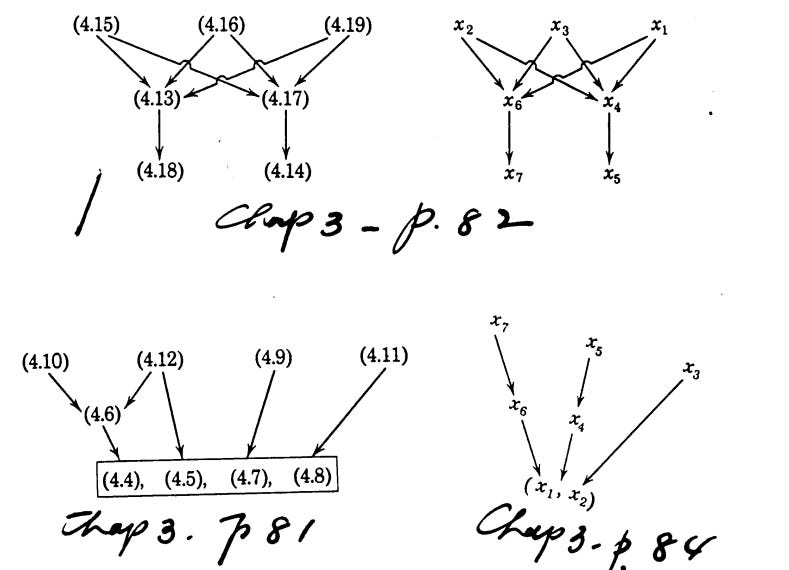
Simon absorbed this insight and formalized it. Where Barnard had described organizational processes qualitatively, Simon sought to model them rigorously. The crucial move was recognizing that organizational behavior could be understood as chains of decisions, each influenced by preceding decisions and organizational context. This was implicitly a causal framework, though Simon did not yet have the mathematical tools to make it explicit. When a manager issued a directive, what caused subordinates to comply or resist? When an organization adopted a new policy, what caused changes in behavior at different organizational levels? These were causal questions requiring systematic analysis of which organizational variables influenced which others and through what mechanisms.
Simon’s time at Berkeley’s Bureau of Public Administration from 1939 to 1942 and then at Illinois Institute of Technology from 1942 to 1949 provided practical experience analyzing organizational structures in municipal governments and public agencies. The work reinforced his conviction that real organizations operated far from the rational ideals assumed by classical administrative theory. Decision-makers lacked complete information, faced time pressure, and relied on simplified decision rules rather than comprehensive optimization. Yet organizations still functioned, often quite effectively. This suggested that organizational structure itself provided a kind of scaffolding that enabled bounded agents to make reasonably good decisions despite cognitive limitations. The causal relationships embedded in organizational structures, the reporting lines and communication channels and standard operating procedures, shaped behavior in ways that individual rationality alone could not explain.
Throughout the 1940s, Simon maintained contact with the Cowles Commission for Research in Economics at the University of Chicago, attending seminars and engaging with the cutting-edge work on econometric identification and structural modeling. Cowles researchers like Trygve Haavelmo and Tjalling Koopmans were developing mathematical methods for distinguishing causal relationships from mere correlations in economic data. The challenge was that multiple causal structures could generate identical statistical patterns, making it impossible to infer causation from correlation alone without additional identifying restrictions. This technical problem in econometrics resonated with Simon’s organizational concerns. Just as econometricians needed to identify which economic variables caused which outcomes, organization theorists needed to identify which organizational structures caused which behaviors. The mathematical tools Cowles was developing might be applicable to organizational analysis.
Simon’s involvement with RAND Corporation in the early 1950s provided another crucial input. RAND brought together mathematicians, economists, engineers, and military strategists to solve complex strategic and operational problems. The interdisciplinary environment exposed Simon to operations research methods, game theory, and early computing technology. RAND’s Systems Research Laboratory, where Simon consulted from 1952 to 1954, studied how Air Force crews made decisions under stress and uncertainty. The research combined behavioral observation with mathematical modeling, exactly the synthesis Simon was pursuing. More importantly, RAND’s culture emphasized practical problem-solving over disciplinary boundaries. The question was not whether a method came from economics, psychology, or engineering, but whether it produced useful insights into real-world systems.
This combination of influences: Barnard’s organizational theory, Chicago’s mathematical economics, Berkeley and IIT’s administrative experience, RAND’s operations research, created the intellectual context in which Simon would formalize his causal framework. When he joined the Cowles Commission officially in 1947 while still at IIT, he brought questions about organizational causation into contact with econometric identification methods. The result was his 1952 paper in the Journal of Philosophy, “On the Definition of the Causal Relation,” which provided a rigorous logical foundation for causal reasoning that transcended temporal sequence and probabilistic association.
Causality Foundations: The Cowles Framework and Its Extensions
Simon’s formal work on causality during the early 1950s represented a radical departure from previous approaches to causal inference. Rather than defining causation through temporal priority or probabilistic dependency, Simon grounded it in logical asymmetry and operational intervention. The key insight was that causal relationships revealed themselves through their invariance under manipulation. If changing X altered Y but changing Y did not alter X, then X causally determined Y, regardless of whether X preceded Y temporally or whether their relationship was deterministic or merely statistical. This intervention-based conception would prove foundational for multiple research programs at GSIA and beyond.
The 1952 Journal of Philosophy paper developed causality as a partial ordering relation among atomic sentences in a formal system of laws. Simon showed how causal structure could be inferred from patterns of logical dependency: variable Y depended causally on variable X if X appeared in the minimal set of equations needed to determine Y’s value, but Y did not appear in the minimal set determining X. This was an inherently asymmetric relationship, capturing the intuition that causes constrain their effects but effects do not constrain their causes. The formalization avoided the philosophical puzzles that had plagued earlier causal theories based on temporal sequence, where simultaneous causation seemed impossible, or on probabilistic correlation, where spurious associations created ambiguity.
Simon’s 1953 Cowles Monograph chapter “Causal Ordering and Identifiability” translated these logical insights into econometric practice. Working with linear structural equation systems, he demonstrated how causal asymmetries could be formalized through coefficient restrictions and used to identify structural parameters from observational data. The crucial distinction was between structural parameters, which remained invariant under policy interventions, and reduced-form coefficients, which changed when causal structures were manipulated. A properly identified causal model would specify relationships that stayed constant even as variables’ values changed through external interventions. This framework enabled rigorous counterfactual reasoning: one could predict what would happen if a policy variable were set to a different value by tracing through the invariant causal relationships that connected it to outcome variables.
The practical implications for policy analysis were profound. Traditional econometric models often fit data well but collapsed when used for policy evaluation because the relationships they estimated were not causally invariant. A correlation between two variables might disappear or reverse when policymakers intervened to change one of them if the correlation reflected a common cause rather than direct causation. Simon’s framework provided tools for distinguishing genuinely causal relationships that would remain stable under intervention from spurious associations that would break down. The approach required identifying minimal determining subsets, the smallest set of variables sufficient to fix another variable’s value, which could then be recognized as that variable’s direct causes.
This formal causal framework connected directly to Simon’s earlier organizational work. In Administrative Behavior, he had argued that organizational structure constrained individual behavior by limiting information flows and defining decision premises. This was implicitly a causal claim: organizational structure caused behavioral patterns by shaping what information agents received and what goals they pursued. The Cowles causality papers provided mathematical tools for making such claims precise and testable. One could model an organization as a system of causal relationships among variables representing information, authority, decisions, and outcomes, then use Simon’s identification methods to determine which organizational features genuinely drove performance and which merely correlated with it.
The extension to certainty equivalence in Simon’s 1956 Econometrica paper “Dynamic Programming under Uncertainty with a Quadratic Criterion Function” represented a further development of the causal framework under uncertainty. Simon showed that when cost functions were quadratic and disturbances satisfied certain distributional assumptions, optimal decision rules could be computed using only the expected values of uncertain future variables rather than their complete probability distributions. This “certainty equivalence” result was fundamentally a claim about causal invariance: the structural parameters governing optimal decisions remained the same whether one treated future variables as certain or uncertain, provided one used their conditional expectations. The causal relationships determining optimal policy were invariant to this particular type of uncertainty.
The result had immediate practical value for production planning problems where firms faced uncertain future demand. Rather than requiring managers to specify complete probability distributions over thousands of possible demand scenarios, certainty equivalence meant they needed only point forecasts of expected demand. The causal structure of the optimization problem, the relationships among production costs, inventory costs, workforce adjustment costs, and demand, remained invariant whether demand was certain or uncertain. One could therefore solve the simpler certainty problem and apply its solution to the uncertainty case simply by replacing certain values with their expectations. This drastically reduced computational requirements while preserving optimality.
Yet certainty equivalence also revealed a tension at the heart of Simon’s project. The result assumed that decision-makers could compute optimal responses to causal structure they understood. But Simon’s bounded rationality work, developing in parallel during the mid-1950s, argued that real agents could not perform such computations. His 1955 paper “A Behavioral Model of Rational Choice” had demonstrated that the computational demands of optimization exceeded human cognitive capacity for realistically complex problems. If agents could not optimize, what was the status of results like certainty equivalence that characterized optimal policies? Simon’s implicit answer was that such results were normatively valuable even if descriptively inaccurate: they told analysts what optimal policies would be, even if real agents could not compute them independently. This created space for operations research as a discipline, but it left unresolved how the causal structure that analysts could identify related to the causal understanding that agents might develop through experience.
Operations and Economics: The CE-HMMS-RE Trajectory
Simon’s certainty equivalence result provided the technical foundation for GSIA’s production planning research and, indirectly, for the rational expectations hypothesis that would eventually emerge from that research. Both developments represented applications of Simon’s causal framework to economic decision-making under uncertainty, but they resolved the tension between formal causal structure and bounded rationality in opposite ways. The production planning approach accepted cognitive limitations and designed systems that accommodated them. The rational expectations approach argued that market mechanisms would drive aggregate behavior toward causal optimality regardless of individual limitations. Simon had provided the causal tools both programs would use without resolving which resolution was correct.
The production planning research that produced the 1960 HMMS book applied certainty equivalence to manufacturing operations. The team studied firms like Pittsburgh Plate Glass Company that faced highly uncertain demand for thousands of products while needing to coordinate production scheduling, inventory management, and workforce planning. Traditional approaches handled these decisions separately and relied on managerial judgment and simple rules of thumb. The result was often chaotic: excessive aggregate inventory coexisting with frequent stockouts of particular products, wildly fluctuating employment levels, and production schedules responding to immediate crises rather than systematic planning. The HMMS team used Simon’s causal framework to model the structural relationships among costs, then applied certainty equivalence to derive optimal decision rules that managers could implement using only demand forecasts.
The approach treated the production system as a causal structure that analysts could identify and manipulate. Quadratic cost functions captured how deviations from optimal production levels, inventory targets, and workforce sizes generated increasing costs. Causal relationships connected these variables: production decisions affected inventory levels, which affected storage costs and stockout risks; workforce decisions affected production capacity, which constrained possible production schedules. Simon’s causality framework enabled the team to specify which relationships were structural, remaining invariant across different planning scenarios, and which were reduced-form associations that would change with policies. Certainty equivalence then simplified optimization by allowing linear decision rules based on expected future demand rather than complex stochastic programming.
The result was a practical management tool that embodied Simon’s causal insights while accommodating bounded rationality. Managers need not understand the underlying causal optimization that generated their decision rules; they needed only to follow simple formulas that took demand forecasts as inputs and produced production schedules, inventory targets, and hiring plans as outputs. The system design assumed a division of labor between analysts who identified causal structure and agents who operated within that structure using simplified rules. This was consistent with Simon’s view that optimization was valuable normatively even when descriptively inaccurate, but it did not address whether agents might learn causal structure through experience or whether market selection might favor firms that discovered such structure independently.
John Muth’s work on the HMMS project led him to question this division between analyst understanding and agent behavior. Examining forecast errors in the production planning data, Muth noticed that firms seemed to learn from mistakes and eliminate systematic biases in their demand predictions. If forecasting errors were truly random and unpredictable, this suggested that firms were using information more effectively than simple adaptive methods would produce. Muth’s insight, developed in his 1960 and 1961 papers, was that competitive pressure might drive aggregate forecasting behavior toward optimality even if individual managers used heuristics. Systematic forecast errors would create profit opportunities that competitors could exploit, forcing firms to improve their forecasting methods or be driven from the market.
The rational expectations hypothesis generalized this insight: in competitive markets, expectations about future economic variables should converge toward the predictions of correct economic models. This was fundamentally a claim about causal learning: market mechanisms would aggregate individual behavior toward outcomes consistent with underlying causal structure even when individuals did not explicitly understand that structure. As economist Michael Lovell later recognized, this meant certainty equivalence actually required rational expectations to deliver optimal outcomes. If Simon’s certainty equivalence framework was correct, and if firms were actually achieving near-optimal performance, then their expectations must be approximately rational in Muth’s sense. The causal structure that certainty equivalence assumed could be identified by analysts must also be discoverable, at least implicitly, by market participants through learning and selection.
Simon rejected this resolution while acknowledging its intellectual power. In his 1991 autobiography, he wrote that Muth “clearly deserves a Nobel” for rational expectations, “even though I do not think it describes the real world correctly.” The disagreement was not about mathematical coherence but empirical accuracy. Muth had shown how Simon’s causal framework could be extended to market aggregates, but Simon doubted that real markets performed the learning and selection functions that would drive outcomes toward causal optimality. The production planning research demonstrated that even sophisticated firms with access to advanced analytical methods often operated far from optimal policies. Expecting market mechanisms to solve problems that individual managers with expert assistance struggled to solve seemed implausible.
The rational expectations program that Robert Lucas and Thomas Sargent later developed built directly on Simon’s causal logic even while rejecting his behavioral conclusions. Lucas’s famous critique of econometric policy evaluation extended Simon’s 1953 distinction between structural and reduced-form parameters. Lucas argued that traditional macroeconomic models estimated reduced-form relationships that would break down when policies changed because they failed to identify genuinely causal structural parameters. If agents formed expectations rationally, then changing policy regimes would cause them to revise their expectations, invalidating any econometric relationships that depended on those expectations. Only models that identified truly structural parameters, causal relationships that remained invariant under policy interventions, could be used for policy analysis. This was precisely Simon’s 1953 argument about identifiability applied to macroeconomic policy.
The irony was complete. Simon’s causality framework, developed to enable rigorous identification of structural relationships for policy analysis, became the foundation for a research program that assumed agents themselves had access to such causal knowledge. The production planning approach had maintained Simon’s distinction between analyst capabilities and agent limitations. The rational expectations approach collapsed that distinction, arguing that market mechanisms effectively gave agents collective access to causal understanding even if individuals remained boundedly rational. Both inherited Simon’s intervention-based conception of causality and his emphasis on structural invariance. They diverged completely on whether bounded rationality constrained equilibrium outcomes or merely described disequilibrium learning processes. Simon’s causality papers had provided the analytical tools that enabled this debate, but they did not resolve it.
Computing and Learning: Alternative Paths to Causal Discovery
While the operations research and rational expectations programs applied Simon’s causal framework to economic decision-making, his parallel work on artificial intelligence and organizational learning suggested a different resolution to the bounded rationality problem. Rather than assuming analysts or markets could identify causal structure independently of agent cognition, the computational approach explored how boundedly rational agents might discover causal relationships gradually through experience, search, and adaptive learning. This represented a third path from Simon’s causality work: not analysts imposing optimal policies on agents, not markets aggregating to optimal outcomes, but agents computationally discovering causal structure within their cognitive constraints.
Simon’s collaboration with Allen Newell and Cliff Shaw on the General Problem Solver, first demonstrated in 1957 at RAND and further developed after they established the artificial intelligence laboratory at Carnegie, embodied causal reasoning as computational search. GPS used means-ends analysis to decompose complex problems into manageable subgoals. The method worked by identifying differences between the current state and a goal state, finding operators that could reduce those differences, and recursively applying the process to subgoals. This was implicitly causal reasoning: operators represented causal mechanisms that produced state changes, and the search process discovered chains of causal interventions that would achieve desired outcomes. The approach did not require complete causal understanding in advance. Agents could discover which operators caused which effects through trial and error, building up causal knowledge incrementally as they solved problems.
The GPS architecture suggested how bounded agents might learn causal structure without the computational resources needed for comprehensive optimization. Rather than analyzing all possible causal relationships simultaneously, means-ends analysis focused attention on relevant causal mechanisms for achieving immediate subgoals. Rather than computing optimal action sequences through dynamic programming, GPS used heuristic search guided by estimates of which operators were most likely to reduce goal distances. The system was explicitly bounded in its rationality, using simplified evaluation functions and limited lookahead, yet it could solve complex problems by exploiting causal structure it discovered through search. This offered a computational resolution to the tension between causal formalism and bounded rationality: agents need not understand complete causal structures to exploit them, provided they could search effectively through spaces of possible causal interventions.
Herb Simon and Jim March’s work on organizational learning, developed through the 1950s and 1960s and formalized in their behavioral theory of the firm, provided a complementary perspective on causal discovery. Organizations learned which actions caused which outcomes through feedback from experience. When a firm adopted a new production method and profits increased, the organization attributed causality and updated its routines. When a pricing change led to lost market share, the organization learned that causal relationship and adjusted its policies. This learning was boundedly rational: organizations attended to a limited set of variables, drew causal inferences from limited data, and often misattributed causation when multiple changes occurred simultaneously. Yet over time, organizations that learned more accurate causal models of their environments performed better and survived, while those with poor causal understanding failed. Market selection operated not on rational expectations but on organizational learning capabilities.
The Cyert-DeGroot attempt at synthesis represented a formal effort to bridge rational expectations and bounded rationality through Bayesian learning. Their 1974 paper “Rational Expectations and Bayesian Analysis” modeled agents who started with uncertain beliefs about causal structure and gradually updated those beliefs through experience. If agents observed outcomes and used Bayes’ rule to revise their probability assessments, they would eventually converge toward accurate causal models regardless of their initial beliefs. This learning process could explain how rational expectations might emerge over time even when agents began with bounded understanding. The approach preserved Simon’s insight that agents faced cognitive limitations while showing how repeated observation could overcome those limitations asymptotically.
Yet the Bayesian synthesis ultimately satisfied neither side fully. From Simon’s perspective, it assumed too much: real agents did not maintain probability distributions over complete model spaces or update them according to Bayes’ rule. The computational demands of Bayesian learning for realistic problems far exceeded human cognitive capacity, merely displacing the bounded rationality problem rather than solving it. From the rational expectations perspective, the learning process created transitional dynamics that complicated equilibrium analysis without adding much explanatory power, since the long-run outcome was rational expectations anyway. The synthesis acknowledged that both sides had legitimate concerns but did not fully resolve the tension between them.
The broader lesson was that Simon’s causality framework could support multiple approaches to the learning problem. Analysts could identify causal structure and design optimal systems. Markets could aggregate behavior toward causal optimality through selection. Computational search could discover causal relationships through heuristic exploration. Bayesian learning could converge toward accurate causal models asymptotically. Organizations could develop causal understanding through feedback and adaptation. Each approach had strengths and limitations. Each represented a different resolution to the gap between the formal causal structures Simon had shown how to identify and the bounded cognitive resources real agents possessed. Simon himself pursued the computational and organizational learning paths after the mid-1950s, treating causality as something agents discovered through experience rather than something analysts imposed or markets enforced. But he recognized value in the alternative approaches even while doubting their empirical adequacy for understanding actual human and organizational behavior.
Modern Legacy: Causal Inference and the Unfinished Synthesis
Herbert Simon’s causality papers from the early 1950s have achieved recognition far beyond their original econometric context, becoming foundational for multiple fields that barely existed when he wrote them. The intervention-based conception of causality that Simon formalized has become the dominant framework in program evaluation, causal inference, and policy analysis. Computer scientists building causal discovery algorithms cite Simon’s 1952 and 1953 papers as pioneering the graphical approach to representing causal structure. Philosophers analyzing counterfactual reasoning trace their frameworks to Simon’s emphasis on intervention and invariance. Researchers in machine learning developing methods for inferring causation from data draw on Simon’s insights about identifiability. Yet the synthesis Simon never completed, between formal causal structure and bounded causal learning, remains unfinished even as modern approaches have developed tools Simon lacked.
Judea Pearl’s development of causal graphical models in the 1990s and 2000s explicitly built on Simon’s work. Pearl credited Simon’s 1952 and 1953 papers as foundational for the idea that causal structure could be represented as directed acyclic graphs with nodes representing variables and edges representing direct causal relationships. Simon’s notion of minimal determining subsets translated directly into the concept of parent nodes in a causal graph, while his emphasis on intervention became the basis for Pearl’s do-calculus. Pearl’s formalism enabled rigorous counterfactual reasoning by specifying which conditional independencies would hold in a system if particular causal interventions were performed. This made Simon’s intervention-based definition of causality computationally tractable, allowing researchers to derive testable implications of causal hypotheses and identify circumstances under which causal effects could be estimated from observational data.
The modern econometric literature on program evaluation and causal identification operationalizes Simon’s framework through methods like instrumental variables, regression discontinuity designs, and difference-in-differences. These techniques all seek to identify causal effects by exploiting quasi-experimental variation that mimics intervention. An instrumental variable provides variation in a treatment that is independent of confounding factors, allowing researchers to estimate causal effects even without randomization. A regression discontinuity design uses sharp cutoffs in assignment rules to compare units just above and below a threshold, approximating a randomized intervention. Difference-in-differences compares changes over time between treated and untreated units, using the untreated as a counterfactual for what would have happened to the treated absent intervention. Each method instantiates Simon’s insight that causation requires identifying relationships that remain invariant under manipulation rather than merely observing correlations that may be spurious.
The distinction Simon drew between structural and reduced-form parameters has become central to modern policy analysis. Policymakers now recognize that models useful for forecasting may be useless for policy evaluation if they fail to identify genuinely causal relationships. A correlation between unemployment and inflation might be stable historically but break down when central banks change monetary policy if the correlation reflected confounding factors rather than direct causation. Only structural models that identify the causal mechanisms through which policy interventions affect outcomes can provide reliable guidance for policy design. This is precisely Simon’s 1953 argument about identifiability, now embedded in the methodology of macroeconomic policy institutions worldwide.
Causal discovery algorithms developed in computer science and statistics automate the process of inferring causal structure from data that Simon had described abstractly. The PC algorithm, proposed by Peter Spirtes and Clark Glymour and building on Simon’s causal ordering, determines which causal structures are consistent with observed conditional independencies in data. The GES algorithm performs greedy search over possible causal graphs to find structures that best explain observed patterns. The FCI algorithm handles cases with unmeasured confounders that Simon’s original framework assumed away. These computational methods address directly the question Simon left unresolved: how can boundedly rational agents discover causal structure when they cannot exhaustively test all possible relationships? The algorithms provide tractable procedures for causal learning under computational constraints, though they require assumptions about faithfulness and causal sufficiency that may not hold in practice.
The machine learning community’s engagement with causality in recent decades has created new connections to Simon’s work. Modern causal machine learning seeks to learn models that generalize across different environments by identifying causal relationships that remain invariant rather than fitting correlations that are distribution-specific. Reinforcement learning agents must discover which actions cause which state changes to learn effective policies, exactly the causal discovery problem that GPS addressed through means-ends analysis. Transfer learning and domain adaptation require understanding which causal relationships generalize to new contexts and which are context-specific. These challenges return to Simon’s fundamental question about the relationship between formal causal structure and bounded learning: how can agents with limited computational resources discover and exploit causal relationships in complex, uncertain environments?
Yet the synthesis Simon never achieved, between causal formalism and bounded rationality, remains elusive in modern research. Pearl’s causal inference framework is fundamentally normative, specifying what causal conclusions are justified given data and assumptions, but not how real agents with cognitive limitations actually reason causally. Modern causal discovery algorithms are computationally expensive and require assumptions about data generating processes that real learners cannot verify. Behavioral economics has documented systematic violations of normatively correct causal reasoning, with humans showing biases in attributing causation, confusing correlation with causation, and failing to recognize confounders. The gap between the causal structures formal methods can identify and the causal understanding real agents develop remains unresolved.
The three paths from Simon’s causality work that emerged at GSIA, analysts imposing optimal policies derived from causal models, markets aggregating to causally optimal outcomes, and computational agents discovering causal structure through learning, now coexist in modern research without clear resolution of which is most appropriate when. Development economists use randomized controlled trials to identify causal effects and design interventions, following the analyst-driven approach. Macroeconomists use rational expectations models assuming markets discover causal structure efficiently. Artificial intelligence researchers build learning agents that discover causal relationships through interaction with environments. Each approach has produced valuable insights. Each leaves unresolved aspects of how bounded rationality constrains causal reasoning.
Simon’s enduring contribution was to establish that causality required intervention and invariance rather than temporal sequence or probabilistic association, providing conceptual foundations that multiple disciplines could build upon. His framework enabled rigorous identification of causal structure from data, making policy analysis and counterfactual reasoning tractable. Yet he never completed the synthesis between the causal structures his formal methods could identify and the causal understanding that bounded agents could develop. GSIA provided a unique institutional environment where these questions could be explored simultaneously through operations research, artificial intelligence, and economic theory. The methodological tensions that eventually fragmented GSIA’s intellectual community reflected not institutional failure but the genuine difficulty of reconciling formal causal structure with bounded causal learning. That challenge remains central to modern research across fields ranging from econometrics to machine learning, a testament to both the power of Simon’s insights and the depth of the problems he identified but did not fully resolve. His causality papers from the early 1950s thus stand as both a completed technical achievement and an unfinished research program, providing tools that multiple generations of scholars have used to address questions Simon raised without claiming to have answered definitively.
Further Readings
Foundational Work
Barnard, Chester I. The Functions of the Executive. Cambridge, MA: Harvard University Press, 1938. The organizational theory classic that influenced Simon’s thinking about decision-making and authority in complex organizations.
Simon, Herbert A. Administrative Behavior: A Study of Decision-Making Processes in Administrative Organization. New York: Macmillan, 1947. Simon’s foundational work on organizational decision-making that established his reputation before the causality papers.
Simon, Herbert A. “On the Definition of the Causal Relation.” The Journal of Philosophy 49, no. 16 (1952): 517-528. The philosophical foundation for intervention-based causality, defining causal ordering as logical asymmetry rather than temporal sequence.
Simon, Herbert A. “Causal Ordering and Identifiability.” In Studies in Econometric Method, edited by William C. Hood and Tjalling C. Koopmans, 49-74. Cowles Commission Monograph No. 14. New York: John Wiley & Sons, 1953. The technical econometric translation of Simon’s causal framework, showing how asymmetric dependencies enable identification of structural parameters.
Simon, Herbert A. “A Behavioral Model of Rational Choice.” Quarterly Journal of Economics 69, no. 1 (1955): 99-118. The paper that formalized bounded rationality and satisficing, creating the tension with causal optimization that Simon never fully resolved.
Simon, Herbert A. “Dynamic Programming under Uncertainty with a Quadratic Criterion Function.” Econometrica 24, no. 1 (1956): 74-81. The certainty equivalence result showing how Simon’s causal framework extended to optimization under uncertainty, bridging causality and operations research.
GSIA Applications and Extensions
Holt, Charles C., Franco Modigliani, John F. Muth, and Herbert A. Simon. Planning Production, Inventories, and Work Force. Englewood Cliffs, NJ: Prentice-Hall, 1960. The HMMS book applying Simon’s causality and certainty equivalence framework to production planning, the project from which rational expectations emerged.
Muth, John F. “Optimal Properties of Exponentially Weighted Forecasts.” Journal of the American Statistical Association 55, no. 290 (1960): 299-306. Muth’s technical precursor exploring when simple forecasting rules are optimal, reverse-engineering the stochastic processes that would rationalize adaptive expectations.
Muth, John F. “Rational Expectations and the Theory of Price Movements.” Econometrica 29, no. 3 (1961): 315-335. The paper introducing rational expectations, extending Simon’s causal framework by arguing that expectations should equal model predictions in competitive markets.
Cyert, Richard M., and Morris H. DeGroot. “Rational Expectations and Bayesian Analysis.” Journal of Political Economy 82, no. 3 (1974): 521-536. GSIA’s attempt to synthesize rational expectations and bounded rationality through Bayesian learning of causal structure.
Newell, Allen, and Herbert A. Simon. “GPS, A Program that Simulates Human Thought.” In Lernende Automaten, 279-293. Munich: R. Oldenbourg, 1961. Description of the General Problem Solver and means-ends analysis as computational causal reasoning.
Simon, Herbert A., and James G. March. Organizations. New York: Wiley, 1958. The behavioral theory of organizations, exploring how firms learn causal relationships through feedback and adaptation.
The Rational Expectations Revolution
Lucas, Robert E., Jr. “Econometric Policy Evaluation: A Critique.” Carnegie-Rochester Conference Series on Public Policy 1 (1976): 19-46. The Lucas Critique applying Simon’s distinction between structural and reduced-form parameters to macroeconomic policy analysis.
Sargent, Thomas J., and Neil Wallace. “Rational Expectations and the Theory of Economic Policy.” Journal of Monetary Economics 2, no. 2 (1976): 169-183. Extension of rational expectations to monetary policy, showing how Simon’s causal invariance logic implied policy ineffectiveness results.
Sargent, Thomas J. Bounded Rationality in Macroeconomics. Oxford: Clarendon Press, 1993. Sargent’s later attempt to reconcile rational expectations with bounded rationality through adaptive learning algorithms.
Modern Causal Inference
Pearl, Judea. Causality: Models, Reasoning, and Inference. Cambridge: Cambridge University Press, 2000. The foundational modern text on causal inference, building explicitly on Simon’s intervention-based definition and causal ordering framework.
Angrist, Joshua D., and Jörn-Steffen Pischke. Mostly Harmless Econometrics: An Empiricist’s Companion. Princeton, NJ: Princeton University Press, 2009. Modern econometric methods for causal identification (IV, RDD, DiD) operationalizing Simon’s emphasis on quasi-experimental variation.
Spirtes, Peter, Clark Glymour, and Richard Scheines. Causation, Prediction, and Search. 2nd ed. Cambridge, MA: MIT Press, 2000. Causal discovery algorithms (PC, FCI) that automate Simon’s causal ordering logic, addressing how bounded agents might learn causal structure computationally.
Imbens, Guido W., and Donald B. Rubin. Causal Inference for Statistics, Social, and Biomedical Sciences: An Introduction. Cambridge: Cambridge University Press, 2015. The potential outcomes framework for causal inference, providing alternative formalization of counterfactual reasoning that complements Simon’s structural approach.
Historical and Philosophical Perspectives
Simon, Herbert A. Models of My Life. New York: Basic Books, 1991. Simon’s autobiography, including his reflections on the Muth collaboration, GSIA institutional tensions, and the relationship between his various research programs.
Crowther-Heyck, Hunter. Herbert A. Simon: The Bounds of Reason in Modern America. Baltimore: Johns Hopkins University Press, 2005. The definitive intellectual biography of Simon, tracing connections among his causality, bounded rationality, and AI work.
Augier, Mie, and James G. March, eds. Models of a Man: Essays in Memory of Herbert A. Simon. Cambridge, MA: MIT Press, 2004. Memorial volume including the Muth and Lovell essays on Simon’s certainty equivalence and its relationship to rational expectations.
Sent, Esther-Mirjam. “Sargent versus Simon: Bounded Rationality Unbound.” Cambridge Journal of Economics 21, no. 3 (1997): 323-338. Analysis of how Sargent’s bounded rationality differs fundamentally from Simon’s, despite surface similarities.
Hoover, Kevin D. “Causality in Economics and Econometrics.” In The New Palgrave Dictionary of Economics, 2nd ed., edited by Steven N. Durlauf and Lawrence E. Blume. London: Palgrave Macmillan, 2008. Overview of causal inference in economics, situating Simon’s contributions within broader development of the field.
Woodward, James. Making Things Happen: A Theory of Causal Explanation. Oxford: Oxford University Press, 2003. Philosophical development of interventionist causality building on Simon’s framework, influential in philosophy of science.